
Virtual Receptionist vs AI Receptionist for Electrical Contractors: Which One Wins More Work?
Virtual Receptionist vs AI Receptionist for Electrical Contractors: Which One Wins More Work?
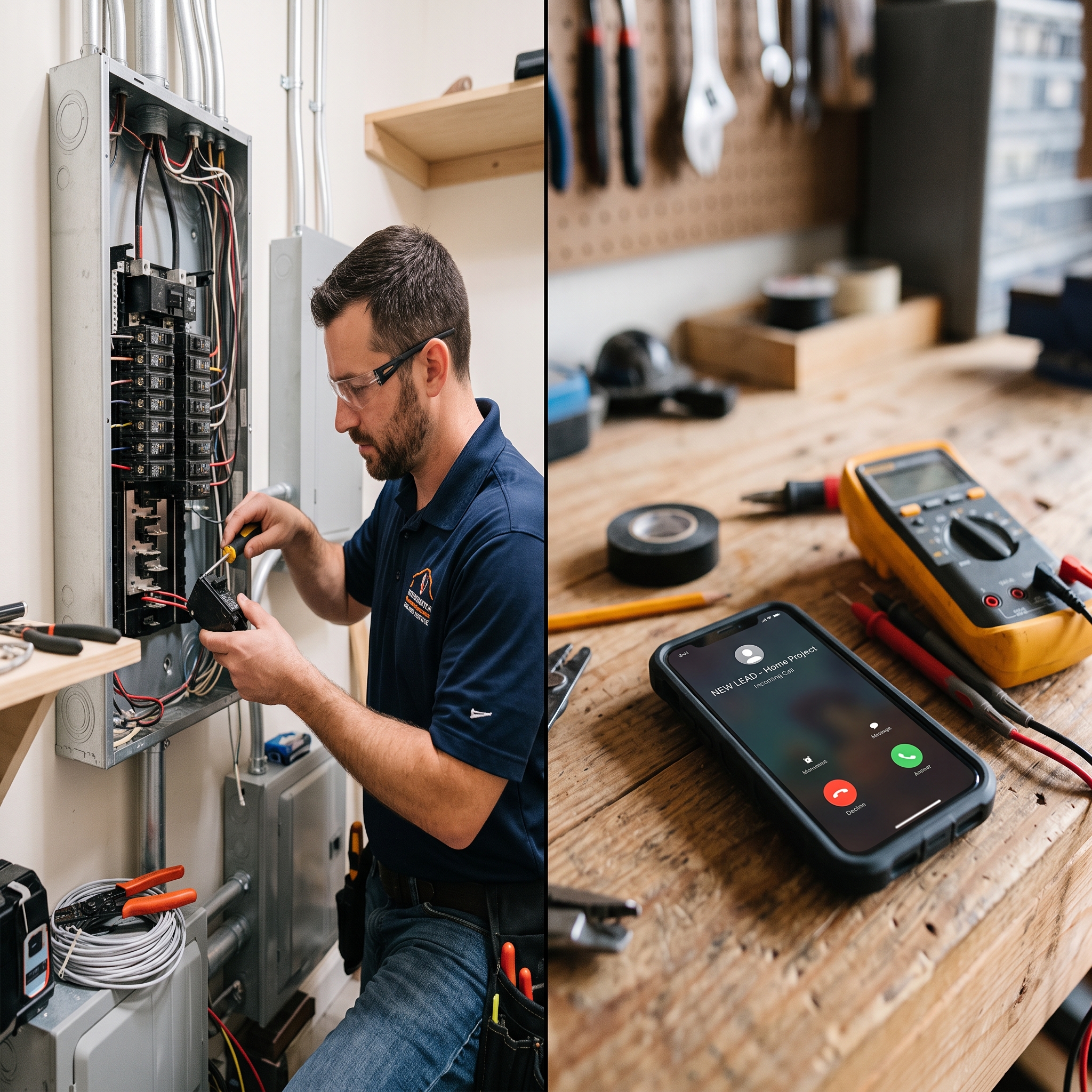
You're up a ladder rewiring a panel, both hands occupied, when your phone buzzes in your pocket. By the time you're back on the ground and call the number back, the homeowner with the dead outlet — or the property manager with three units and no power — has already booked another electrician. In the trades, the first company to answer wins the job most of the time, and electrical work is no exception.
That's why nearly every growing electrical contractor eventually shops for phone coverage. The choice usually comes down to two options: a virtual receptionist (a live human answering remotely through an answering service) or an AI receptionist (software that answers, qualifies, and books calls automatically). Both promise to stop the bleeding. They behave very differently once real call patterns — storm surges, 9 PM breaker trips, tire-kicker quote calls — start hitting the line.
Here's the honest comparison, with numbers you can check against your own call log.
Quick Definitions
Virtual receptionist: A trained human, usually shared across dozens of client businesses, who answers your calls remotely, follows your script, takes messages, and may book simple appointments. Billing is typically per minute or per call.
AI receptionist: Software that answers conversationally, asks the qualifying questions an electrician actually needs answered (Is anything sparking or smelling like burning? Is the whole house out or one circuit? Is this a home or commercial property?), books the job onto your calendar, and texts the caller a confirmation. It picks up instantly, 24/7, and can handle any number of calls at once.
Head-to-Head Comparison
| Factor | Virtual Receptionist | AI Receptionist |
|---|---|---|
| Typical cost | $300–$1,200+/mo (per-minute billing) | $99–$500/mo flat |
| Availability | Business hours; 24/7 costs extra | 24/7/365 included |
| Simultaneous calls | One per agent | Unlimited |
| Answer speed | 3–5 rings | Under 2 seconds |
| Electrical knowledge | Generic multi-industry script | Trained on your services and pricing |
| Safety triage | Reads a checklist | Applies your escalation rules instantly |
| Storm-surge handling | Overflow hits hold or voicemail | Every call answered, no queue |
| Outcome per call | Message taken | Job booked + confirmation text |
Why Phone Coverage Is Different for Electricians
Electrical calls have two traits that stress-test any answering setup harder than most trades:
1. Safety urgency is binary. A caller reporting flickering lights is a schedulable job. A caller reporting a burning smell from the panel is an emergency that needs escalation now. Whoever answers your phone has to tell the difference in the first thirty seconds — and route accordingly, every single time, including at 11 PM.
2. Job values swing wildly. The same phone line delivers $150 outlet swaps, $650 troubleshooting calls, $2,500 panel upgrades, $1,800 EV charger installs, and five-figure rewires. You can't tell which is which until someone asks the right questions. A receptionist who just takes a name and number treats a panel-upgrade lead exactly like a price-shopper — and both go into the same callback pile.
Keep those two traits in mind as you weigh the options.
Where the Virtual Receptionist Wins
Live humans still hold genuine advantages:
Emotional, messy conversations. A landlord juggling angry tenants after an outage, or a homeowner rattled by a small electrical fire, sometimes needs a patient human ear. Good agents de-escalate in ways scripts don't capture.
Odd exceptions. "The gate code is 4471 but the dog is out until noon, and my husband handles the billing" — humans absorb messy details without breaking stride.
A human-first brand. If your book of business is long-term commercial maintenance accounts who expect to reach a person, that preference is real and worth respecting.
But notice the pattern: these advantages show up on a minority of calls. The bulk of your inbound volume — "Do you do EV charger installs?", "What do you charge for a service call?", "Half my kitchen has no power, can someone come out?" — is repetitive, urgent, and winner-take-all on response speed. That's exactly where per-minute human labor gets expensive and instant software gets dominant.
Where the AI Receptionist Wins
1. The 9 PM breaker that won't reset
Electrical emergencies don't respect business hours — panels fail at dinner time, outlets spark on weekends, and storm damage arrives whenever the storm does. Standard virtual receptionist plans cover business hours; true 24/7 human coverage often doubles the bill. An AI receptionist answers the 9 PM call instantly, runs your safety triage ("Is anything hot, sparking, or smelling like burning? If so, we'll treat this as an emergency"), and either books the first morning slot or escalates to your on-call phone according to rules you set.
2. Storm surges break human queues
When a storm knocks out power across your service area, your call volume can jump 5–10x in an afternoon. Here's the structural problem: your answering service staffs for average volume across all its clients — and the same storm is lighting up their other clients' lines too. Hold times stretch, callers hang up and dial the next electrician. The week you should be booking solid is the week your phone coverage quietly collapses. An AI receptionist answers call one and call fifty simultaneously, with zero hold time.
3. Qualified bookings, not phone tag
A typical virtual receptionist message reads: "Mike, 555-0193, electrical issue, please call back." That's not a booked job — it's homework. You still have to win the callback game against every other contractor Mike called. An AI receptionist finishes the play on the first call: identifies the issue, captures the address and panel details, checks your real availability, books the appointment, and texts a confirmation. For high-ticket leads like panel upgrades or EV charger installs, it flags the opportunity so you see it first.
4. Per-minute billing punishes your best months
Virtual receptionist services generally run $1.20–$2.00 per minute, and a proper electrical intake call — symptoms, safety check, address, scheduling — takes 4–6 minutes. At 200 calls a month you're paying $960–$2,400, and the meter runs faster every time your Google ads or referral engine performs. Flat-rate AI pricing inverts that: the more calls you take, the cheaper each lead gets.
5. Missed-call textback catches the hang-ups
Some callers bail after one ring or misdial and don't retry. Modern AI receptionist platforms fire an automatic text within seconds: "Sorry we missed you — is this about an electrical issue at your home or business?" That one feature recovers leads that voicemail loses forever. No traditional answering service does this by default.
The Real Cost Comparison for an Electrical Contractor
Run the math for a typical owner-operated electrical shop handling ~200 calls per month, with an average booked job around $500:
Virtual receptionist service:
- 200 calls × 5 min × $1.50/min = $1,500/mo
- Business hours only; after-hours coverage adds $300–$500/mo
- Output: messages, not bookings — you still fight the callback battle on every lead
AI receptionist (using Omni AI's published pricing as the benchmark):
- Solo plan: $99/mo flat — AI receptionist, intake specialist, scheduler, and sales manager, plus missed-call textback and Google review management
- Growth plan: $199/mo — adds win-back sequences, a Monday business snapshot text, and CRM integrations
- 24/7 answering and unlimited simultaneous calls included at every tier
If the AI books just two extra jobs a month that would have died in voicemail or hold-time — one troubleshooting call and one panel quote — that's roughly $1,000 in recovered revenue against a $99–$199 cost. The human service has to justify a bill 8–15x higher while covering fewer hours and taking messages instead of bookings.
Decision Framework: Which Should Your Electrical Business Choose?
Choose a virtual receptionist if:
- Your volume is low (under ~50 calls/month) and stable
- Most calls are existing commercial accounts with contract-specific questions
- A live human greeting is a genuine differentiator with your customer base
Choose an AI receptionist if:
- You miss calls while on ladders, in panels, or after hours (that's nearly every electrician)
- You want jobs booked, not messages stacked up
- Storms or seasonal demand make your call volume spike
- You're tired of per-minute bills that grow with your success
- You're already paying $1,000+/mo for an answering service and still losing after-hours emergencies
The hybrid reality: Many growing electrical contractors run AI-first. The AI answers everything instantly, books the routine 80%, applies your safety-escalation rules, and hands the genuinely complex 20% to you or your office manager with a full transcript. You keep human judgment where it earns its cost — and stop paying human rates to answer "Do you service my zip code?"
What to Look For in an AI Receptionist for Electrical Work
Before signing up with any platform, verify:
- Trade-aware intake — it should handle "breaker keeps tripping," "GFCI won't reset," and "200-amp panel upgrade," not just generic scheduling
- Safety escalation rules you control — you decide what counts as an emergency and who gets woken up
- Real calendar booking — direct scheduling into your calendar, not "someone will call you back"
- Missed-call textback — instant SMS recovery on any unanswered ring
- Follow-up automation — quotes chased, reviews requested, past customers re-engaged for panel and EV-charger upsells
- Flat, transparent pricing — no per-minute meter, no overage surprises
The Bottom Line
A virtual receptionist gives you a human voice at a premium price with hard structural limits: one call at a time, business hours by default, and a message where a booked job should be. An AI receptionist gives you instant, surge-proof, 24/7 answering that qualifies safety issues and books work directly onto your calendar — at a fraction of the cost.
For electrical contractors in 2026, missed calls are the most expensive leak in the business. The tool that seals it — for $99 a month instead of $1,500 — is the AI.
Want to see exactly what an AI receptionist costs versus what missed calls are costing you? Omni AI publishes its full pricing openly — from the $99/mo Solo plan (stop missing calls) to a complete AI department that runs your front office end to end. See Omni AI's pricing, explained plan by plan →
Every electrician in your market gets the same after-hours calls you do. The difference is whose phone actually answers.
Get the AI Playbook — $29
46 copy-paste prompts for marketing, sales, service, operations & finance. 90-day implementation plan included.
Get the PlaybookAI Prompt Pack for Real Estate Agents — $29
60+ prompts built from $250M+ in real transactions. Listings, negotiations, social media, sphere management.
Get the RE Prompt PackAI Social Media Content Calendar Kit — $29
Plan 90 days of content in under 1 hour. 35+ AI prompts, 12-week calendar, strategies for Instagram, LinkedIn, TikTok, Facebook & X.
Get the Calendar KitThe AI Email Marketing Playbook — $29
40+ copy-paste prompts for welcome sequences, sales funnels, newsletters, automation workflows & A/B testing. Build campaigns that convert.
Get the Email PlaybookThe n8n Automation Cookbook — $29
25 ready-to-deploy workflows for lead capture, CRM, invoicing, email, social media, reporting & e-commerce. Save $774/yr vs Zapier.
Get the n8n Cookbook✭ Complete AI Marketing Toolkit — All 5 Products for $119 (Save $26)
195+ prompts + 25 workflows across business, real estate, social media, email marketing & automation. One purchase, lifetime updates.
Get the Complete Bundle