
Virtual Receptionist vs AI Receptionist for Cleaning Businesses: Which One Actually Fills Your Schedule?
Virtual Receptionist vs AI Receptionist for Cleaning Businesses: Which One Actually Fills Your Schedule?
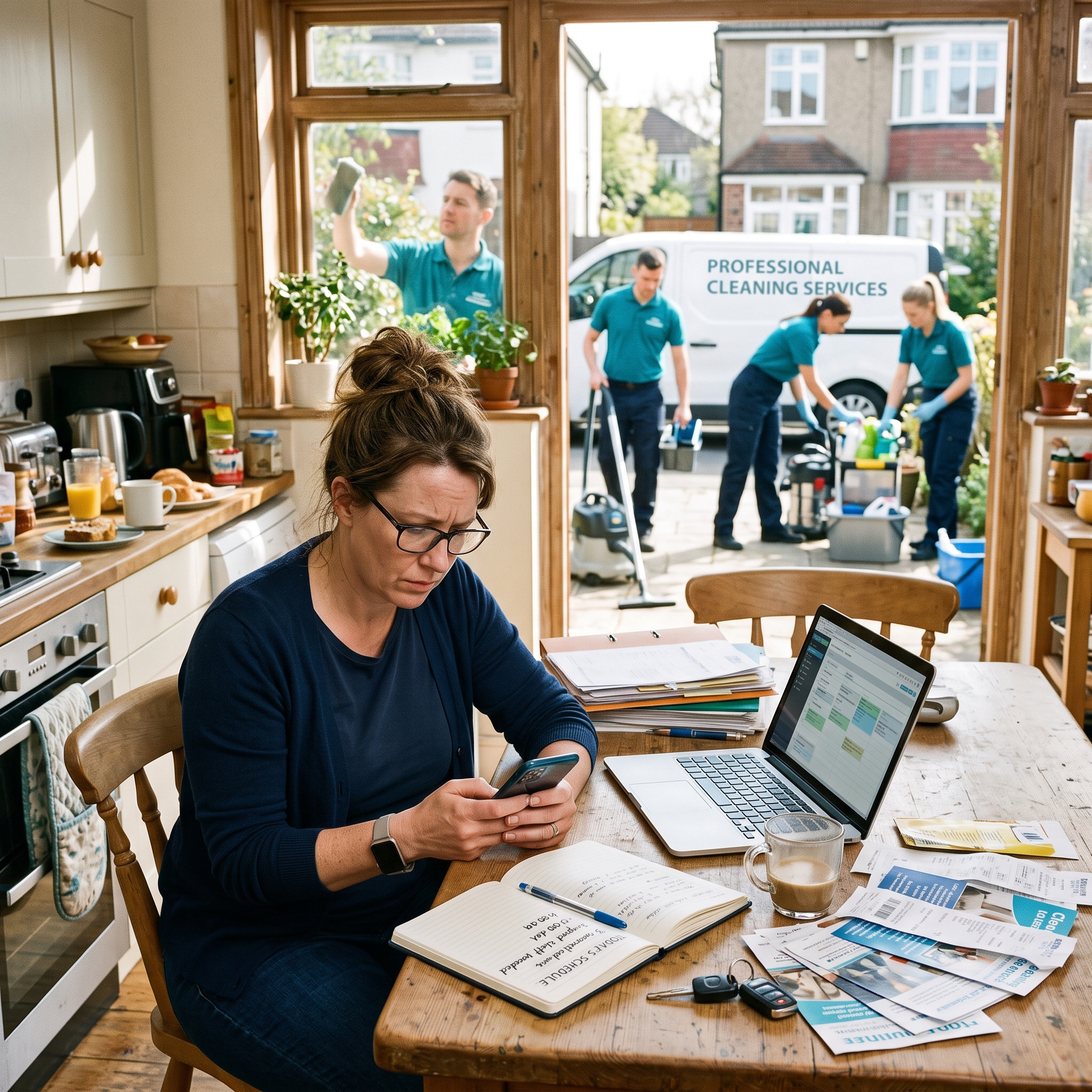
Here's the moment every cleaning business owner knows: you're mid-deep-clean in a client's kitchen, gloves on, hands in a sink — and your phone buzzes in your pocket. It's a new lead calling for a quote. You can't answer. By the time you call back that evening, they've already booked one of the other three companies they called.
That's not bad luck. That's the default outcome. Most homeowners looking for a cleaner call two to four companies and book with whoever responds first. If your phone goes to voicemail during working hours — which for a cleaning business is exactly when the calls come in — you're quietly funding your competitors' schedules.
So the real question isn't whether you need someone answering your phone. It's who — or what — should be doing it. For most cleaning businesses, that decision comes down to two options: a virtual receptionist (a real human answering remotely through a service) or an AI receptionist (software that answers, quotes, qualifies, and books automatically). Here's the honest comparison, with real numbers.
Quick Definitions
Virtual receptionist: A trained human — usually shared across dozens of client businesses — who answers your calls remotely, follows your script, takes messages, and may schedule appointments. You typically pay per minute or per call through an answering service or virtual receptionist agency.
AI receptionist: Software trained to answer calls conversationally, ask the qualifying questions that matter for cleaning ("House or apartment? How many bedrooms and bathrooms? One-time deep clean or recurring service?"), give ballpark pricing if you allow it, book the walkthrough or the job directly onto your calendar, and text the caller a confirmation. It answers instantly, around the clock, and can handle any number of calls at once.
Head-to-Head Comparison
| Factor | Virtual Receptionist | AI Receptionist |
|---|---|---|
| Typical cost | $250–$1,000+/mo (per-minute billing) | $99–$500/mo flat |
| Availability | Business hours; 24/7 costs extra | 24/7/365 included |
| Simultaneous calls | One call per agent | Unlimited |
| Answer speed | 3–5 rings on average | Under 2 seconds |
| Cleaning-specific intake | Generic script shared across industries | Trained on your services, pricing, and service area |
| Quote requests | Takes a message for callback | Collects bed/bath count, quotes or books the estimate |
| Missed-call recovery | None by default | Automatic textback within seconds |
| Consistency | Varies by agent and shift | Identical on every call |
Where the Virtual Receptionist Wins
Human receptionists still have genuine advantages, and it's worth being honest about them:
Emotionally loaded conversations. A long-term client upset about a broken vase or a billing dispute sometimes needs a patient human ear. Good agents read tone and de-escalate in ways a script can't fully replicate.
Messy exceptions. "The gate code changed, the dog needs to be in the garage, and my mother-in-law answers the door but doesn't speak English" — a human handles chaos like this without blinking.
The personal-touch brand. Some boutique cleaning companies build their identity around white-glove service, and a live human greeting can be part of that positioning.
But look at what those advantages have in common: they show up on a small fraction of calls. The bulk of your inbound volume — "How much for a 3-bed, 2-bath?", "Do you do move-out cleans?", "Can you come Friday instead?", "Do you bring your own supplies?" — is repetitive, predictable, and time-sensitive. That's exactly the territory where humans get expensive and AI gets dominant.
Where the AI Receptionist Wins
1. You clean during business hours — so do your missed calls
This is the structural problem unique to cleaning businesses: your revenue-producing work and your phone-answering hours are the same hours. A plumber's office manager can pick up while the plumber is under a sink. A solo or small-crew cleaning operation has nobody free from 9 to 4. A virtual receptionist solves this — but so does AI, at a fraction of the price, and the AI never calls in sick during your busiest week.
2. Quote requests get answered, not queued
Cleaning leads almost always want a number before they commit. A virtual receptionist working from a generic script takes down "3 bed, 2 bath, wants a quote" and promises a callback — and callbacks lose. An AI receptionist trained on your rate card can collect the details, give your standard range, and book the walkthrough or first clean in the same call. The lead never re-enters the shopping pool.
3. Evening and weekend booking windows
Homeowners research cleaning services after work and on weekends — precisely when answering service coverage gets expensive. True 24/7 human coverage often doubles the bill. An AI receptionist treats a Sunday 8 PM caller exactly like a Tuesday 10 AM caller: answers instantly, quotes, books, confirms by text.
4. Per-minute math punishes growth
Virtual receptionist services typically bill $1.20–$2.00 per minute. A proper cleaning intake call — bedrooms, bathrooms, pets, frequency, add-ons, scheduling — runs 5–7 minutes. At 150 calls a month, that's $900–$2,100, and the meter runs faster every time your marketing works. Flat-rate AI pricing means your cost per lead drops as call volume grows.
5. The missed-call textback safety net
Even a great system misses the occasional call — the caller hangs up on the first ring or dials while you're mid-transfer. Modern AI receptionist platforms fire an automatic text within seconds: "Sorry we missed you! Are you looking for a one-time clean or recurring service?" That one feature routinely recovers leads that would have vanished. No human answering service does this by default.
6. Recurring revenue depends on follow-up, not just answering
Cleaning is a recurring-revenue business. The difference between a $180 one-time clean and a $4,300-a-year biweekly client is usually one follow-up message that never got sent. An AI receptionist that's part of a broader AI front office doesn't stop at answering — it chases the quote, nudges the one-time client toward a recurring slot, and asks the happy customer for a Google review.
The Real Cost Comparison for a Cleaning Business
Run the numbers for a typical owner-operated cleaning company taking ~150 calls per month, where a new recurring client is worth roughly $2,000–$4,500 a year:
Virtual receptionist service:
- 150 calls × 6 min average × $1.50/min = $1,350/mo
- Business-hours coverage only; evenings and weekends cost extra
- Messages taken, not jobs booked — you still do the callbacks, and every callback hour is an hour you're not cleaning
AI receptionist (using Omni AI's published pricing as the benchmark):
- Solo plan: $99/mo flat — AI receptionist, intake specialist, scheduler, and sales manager, plus missed-call textback and Google review management
- Growth plan: $199/mo — adds win-back sequences for lapsed recurring clients, a Monday business snapshot text, and CRM integrations
- 24/7 coverage and unlimited simultaneous calls included at every tier
If the AI converts even one extra recurring client per month that the human service would have lost to a callback delay, that's $2,000+ in annual revenue against a $99–$199 monthly cost. The virtual receptionist needs to justify a bill 7–13x higher while covering fewer hours and still leaving the booking to you.
Decision Framework: Which Should Your Cleaning Business Choose?
Choose a virtual receptionist if:
- Your call volume is very low (under ~40 calls/month) and steady
- Most calls are established clients with account-level questions
- A live human voice is a core part of a premium brand you actively market
Choose an AI receptionist if:
- You or your crew are cleaning during the hours leads call (this is nearly every cleaning business)
- You want quotes handled and jobs booked, not messages stacked up for tonight
- You get evening and weekend inquiries you currently lose to voicemail
- You want flat, predictable pricing instead of a per-minute meter
- You're trying to grow recurring clients and need follow-up to happen automatically
The hybrid reality: Plenty of growing cleaning companies run AI-first — the AI answers everything instantly, quotes and books the routine 80%, and escalates the genuinely tricky 20% to the owner with a full transcript. You keep human judgment where it matters without paying human rates for "How much is a deep clean?"
What to Look For in a Cleaning-Business AI Receptionist
Before you sign up for anything, verify:
- Cleaning-specific intake — bed/bath count, square footage, frequency, add-ons like ovens and windows, pet questions
- Real calendar booking — the caller leaves the call with a slot, not a promise of a callback
- Missed-call textback — instant SMS recovery on any unanswered ring
- Quote handling rules you control — give ranges, exact rates, or book a walkthrough; your call
- Follow-up automation — quotes chased, one-timers nudged to recurring, reviews requested
- Flat, transparent pricing — no per-minute meter, no overage surprises
The Bottom Line
A virtual receptionist gives you a human voice at a premium price with structural limits: one call at a time, business hours by default, and a message where a booking should be. An AI receptionist gives you instant, 24/7 answering that quotes, books, and follows up — for less than you'd pay a human service for half the coverage.
For cleaning businesses in 2026, the math is blunt. Your hands are busy during the exact hours your leads call, and every missed call is a recurring client someone else just signed. The tool that plugs that leak best — at $99/month instead of $1,000+ — is the AI.
Ready to see exactly what an AI receptionist costs versus what missed calls are costing you? Omni AI publishes its full pricing openly — from the $99/mo Solo plan (stop missing calls) to the full AI department that runs your front office end to end. See Omni AI's pricing, explained plan by plan →
Your next recurring client is going to call somebody this week. Make sure the phone that answers is yours.
Get the AI Playbook — $29
46 copy-paste prompts for marketing, sales, service, operations & finance. 90-day implementation plan included.
Get the PlaybookAI Prompt Pack for Real Estate Agents — $29
60+ prompts built from $250M+ in real transactions. Listings, negotiations, social media, sphere management.
Get the RE Prompt PackAI Social Media Content Calendar Kit — $29
Plan 90 days of content in under 1 hour. 35+ AI prompts, 12-week calendar, strategies for Instagram, LinkedIn, TikTok, Facebook & X.
Get the Calendar KitThe AI Email Marketing Playbook — $29
40+ copy-paste prompts for welcome sequences, sales funnels, newsletters, automation workflows & A/B testing. Build campaigns that convert.
Get the Email PlaybookThe n8n Automation Cookbook — $29
25 ready-to-deploy workflows for lead capture, CRM, invoicing, email, social media, reporting & e-commerce. Save $774/yr vs Zapier.
Get the n8n Cookbook✭ Complete AI Marketing Toolkit — All 5 Products for $119 (Save $26)
195+ prompts + 25 workflows across business, real estate, social media, email marketing & automation. One purchase, lifetime updates.
Get the Complete Bundle