
Missed Call Text Back Service for House Cleaners: Stop Losing Recurring Clients to Voicemail
Missed Call Text Back Service for House Cleaners: Stop Losing Recurring Clients to Voicemail
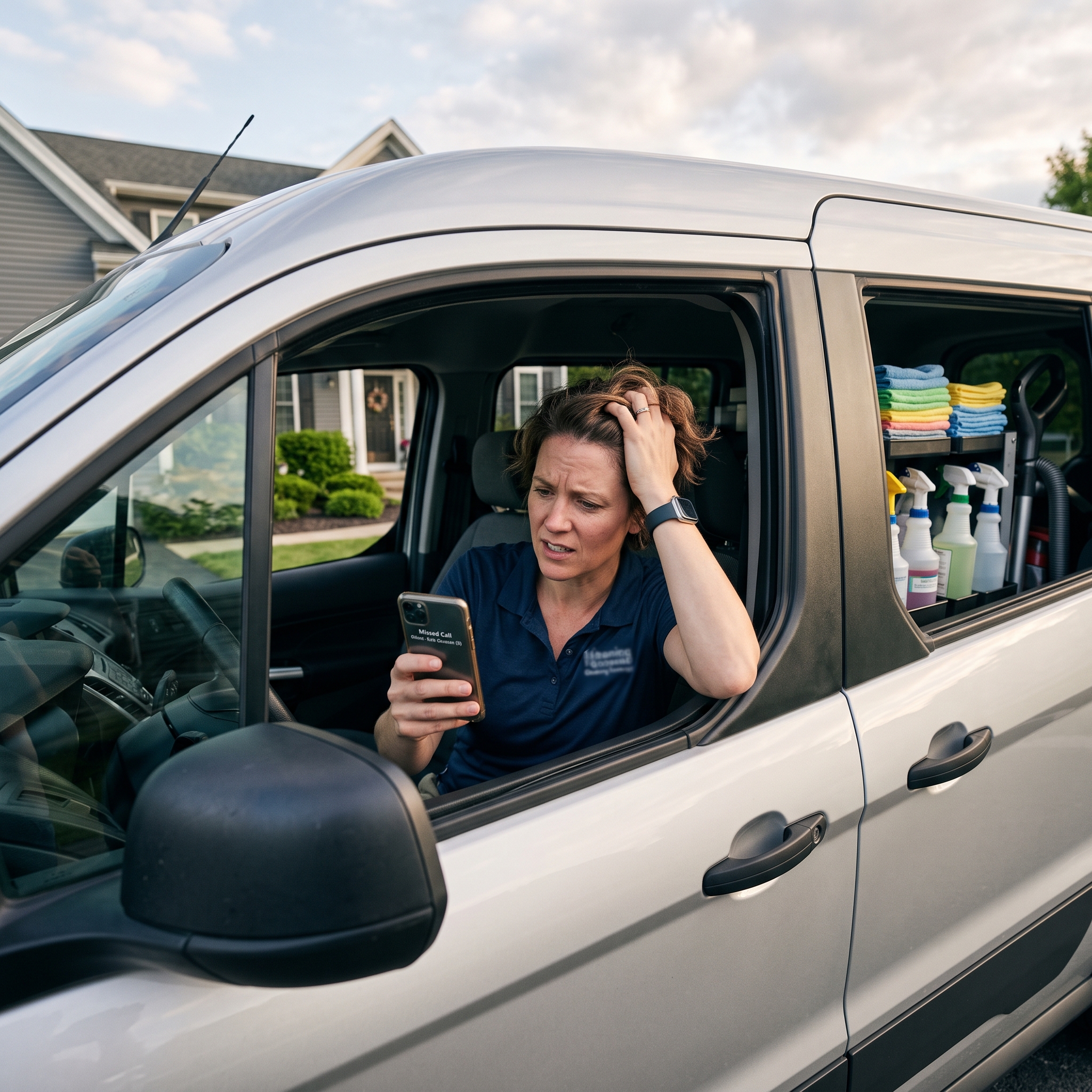
You're elbow-deep in someone's oven, gloves on, music or a podcast in one ear. Your phone buzzes in the other room — because you don't take calls inside a client's home, and you shouldn't. By the time you're loading the car two hours later, the caller is gone. Roughly 80% of callers who hit voicemail never leave a message. They just dial the next cleaning company in their search results.
For house cleaners, that stings more than almost any other trade. The person calling probably wasn't shopping for a single visit. Most inquiries are for recurring service — weekly, bi-weekly, or monthly cleans. A missed call isn't a missed $150 job. It's often a missed $3,000–$6,000 per year client who would have stayed with you for years and referred their neighbors.
A missed call text back service closes that leak. The moment a call rings out, the caller automatically receives a text: "Hi, this is Brightside Cleaning — sorry we missed you! Are you looking for recurring cleaning, a deep clean, or a move-out clean? Reply here and we'll get you a quote." The lead stays warm, the conversation moves to text — where most homeowners prefer to communicate anyway — and the client stays in play.
This guide covers how missed call text back works for cleaning businesses specifically, what missed calls actually cost when recurring revenue is on the line, what separates a basic auto-text from a real lead-recovery system, and how to get one running this week.
Why House Cleaners Miss So Many Calls
Missed calls in a cleaning business aren't a discipline problem — they're built into how the work happens:
- You're inside clients' homes all day. Answering your phone mid-clean is unprofessional at best. Many cleaners keep phones silenced or in the car for exactly that reason.
- Your hands are literally full. Gloves, chemicals, vacuums running. Even if you wanted to answer, you often physically can't.
- Small teams have no office. If you're a solo cleaner or run two or three teams, you're also the estimator, the scheduler, and the receptionist. Nobody's job is the phone.
- New clients call while they're free — evenings and weekends. A working homeowner researching cleaning services at 7:30 PM on a Tuesday gets your voicemail, not you. Same for the Sunday-afternoon planner getting ready for the week.
- Move-out and Airbnb calls are urgent. A tenant who needs a move-out clean by Friday, or a host with a same-week turnover gap, books whoever responds first. Those callers don't wait hours — they don't even wait thirty minutes.
Industry studies consistently put the missed-call rate for home services businesses between 20% and 30% of inbound calls. For solo cleaners and small teams working inside homes all day, the real number is often higher.
The Math: What Missed Calls Cost a Cleaning Business
Cleaning is a lifetime-value business, so per-job math dramatically undersells the damage. Run your own numbers, but here's a conservative baseline:
| Input | Conservative estimate |
|---|---|
| Inbound calls per month | 60 |
| Missed (25%) | 15 |
| Callers who are real prospects | 10 |
| Prospects lost without follow-up | 8 |
| Blended value per lost prospect* | $1,100 |
| Monthly revenue lost | $8,800 |
* That blended figure assumes a mix: some lost callers wanted a one-time deep clean or move-out clean ($200–$450), but several wanted recurring service. A bi-weekly client at $160 per visit is worth over $4,100 a year — and the average recurring cleaning client stays two to three years. One lost weekly client can quietly cost you more than $10,000.
Now the recovery side. Businesses using missed call text back typically re-engage 40–60% of missed callers, because the text lands within seconds — while the homeowner is still holding their phone, still in "find a cleaner" mode. Even recovering a third of those lost prospects puts thousands per month back on your schedule. And recovered cleaning leads compound like nothing else: the bi-weekly client you save in August pays you every two weeks indefinitely, books holiday deep cleans, and refers the neighbor across the street.
How a Missed Call Text Back Service Works
The mechanics are simple:
- A call rings your business line and goes unanswered — you're mid-clean, it's after hours, or you're driving between jobs.
- The system detects the missed call instantly and fires a text to the caller from your business number.
- The caller replies by text, describing what they need: "Looking for bi-weekly cleaning for a 3-bed, 2-bath in Riverside."
- The conversation continues — either you jump in between jobs, or (with an AI-powered system) an AI receptionist qualifies the lead, answers questions about your services, and books the walkthrough or first clean without you touching your phone.
- The lead is logged with name, number, address, home size, and service type, so nothing lives only in your text history.
The difference between a basic auto-responder and a real lead-recovery system is what happens at steps 3–5. A dumb auto-text says "we'll call you back" and leaves the follow-up to you — which, on a day with four houses booked, means it doesn't happen. A system with AI behind it actually carries the conversation: it asks recurring or one-time, collects bedrooms and bathrooms, mentions whether you bring supplies, and puts the estimate or first clean on your calendar.
What to Look For (Cleaning-Business Checklist)
Not every missed call text back tool fits a cleaning business. Before you sign up for anything, check for:
Speed. The text needs to land within seconds. The homeowner comparing cleaners has three more tabs open, and the move-out caller is booking today, period.
Two-way conversation, not a one-shot blast. If the system can't handle "Do you bring your own supplies?" or "Can you do a price for bi-weekly instead of weekly?", you've just moved the dead end from voicemail to SMS.
Service-type triage. Recurring service, one-time deep clean, move-in/move-out, post-construction, Airbnb turnover — these have different values, different pricing, and different urgency. The system should ask, and route accordingly, so a potential weekly client doesn't sit in the same pile as a one-off inquiry.
Quote-ready intake. Cleaning quotes depend on home size, condition, frequency, and add-ons. The best systems collect bedrooms, bathrooms, square footage, and pets up front, so you can quote from a text thread instead of playing three rounds of phone tag.
A business number, not a random one. Texts should come from the same number the customer just called. Replies from unknown numbers get ignored or flagged as spam.
Follow-up sequences. Some callers won't answer the first text. A good system nudges them a few hours later and again the next morning. Most cleaning companies never follow up even once — a single second touch will separate you from every other company the homeowner called.
Flat pricing. Spring cleaning season and the pre-holiday rush triple your call volume. Predictable pricing beats per-message billing that spikes exactly when you're busiest.
Standalone Text-Back Tool vs. AI Front Office
You have two ways to solve this:
Option 1: A standalone missed call text back app. Cheap ($20–$50/month), quick to set up, better than nothing. But it patches one hole. You still have nobody answering the calls you could have caught, nobody qualifying leads, nobody chasing the quotes you sent last week, and nobody asking happy clients for the Google reviews that win you the next client.
Option 2: An AI employee that includes text-back as one of its jobs. This is where the market has moved in 2026. Instead of a single-feature app, you get an AI receptionist that answers calls 24/7 in a natural voice — including the 7:30 PM callers you'll never catch from inside a client's home — and when a call still slips through, missed call text back kicks in as the safety net. The same system handles intake, books estimates and first cleans, follows up on open quotes, and manages your Google reviews.
For most cleaning businesses, option 2 costs about the same as a mid-tier standalone tool and replaces three or four of them. A human answering service, by comparison, runs $300–$1,200/month and still just takes messages — nobody at a call center can quote your bi-weekly rate for a 3-bed/2-bath, explain your pet policy, or book a walkthrough onto your calendar.
What This Looks Like with Omni
Omni was built for exactly this scenario — owner-operated home services businesses where the owner is the front office. Instead of another app to manage, you get a department of AI employees:
- An AI receptionist answers every call, 24/7, so far fewer calls are missed in the first place — including the evening callers and the Sunday planners.
- Missed call text back fires instantly on anything that does slip through — included on every plan, starting with Solo at $99/month.
- An intake specialist qualifies the lead by text: recurring or one-time, home size, pets, preferred days, move-out deadlines.
- A scheduler books the walkthrough or first clean straight onto your calendar.
- A sales manager follows up on quotes that haven't closed — the estimate you sent for that deep clean doesn't die in the prospect's inbox — and the system manages your Google reviews and Business Profile.
A homeowner who calls at 7:45 PM while you're having dinner doesn't get voicemail. They get an answer — or at minimum an instant text — a few qualifying questions, and a confirmed slot. You get a lead summary and a fuller recurring schedule.
Setting It Up: A One-Week Plan
- Day 1 — Measure the leak. Pull last month's phone records. Count missed calls, multiply by your close rate and blended client value. If you count recurring clients at their annual value, the number is usually uncomfortable.
- Day 2 — Pick your system. Decide between a standalone patch and a full AI front office. If you're a solo cleaner or run one or two teams, the AI-employee route at $99/month is usually cheaper than stacking point tools.
- Day 3 — Write your text templates. Short, named, question-ended: "Hi, it's [Business Name] — sorry we missed your call! Are you looking for recurring cleaning, a deep clean, or a move-out clean? Reply here and we'll get you a quote."
- Day 4 — Configure intake questions. Bedrooms, bathrooms, pets, frequency, timing. Decide which inquiries (move-outs on a deadline, commercial contracts) escalate straight to your cell.
- Day 5 — Test it yourself. Call your own line from another phone, let it ring out, and experience what your customers experience. Fix anything awkward.
- Days 6–7 — Watch the recovered leads arrive. Track how many missed callers reply and book. Most cleaning businesses see recovered quotes within the first week — and during spring or pre-holiday season, often the first day.
The Bottom Line
Every cleaning business already pays for missed calls — most just pay in invisible lost clients instead of a visible monthly fee. A missed call text back service converts that silent leak into booked walkthroughs for less than you charge for a single standard clean. And because cleaning revenue recurs, every recovered weekly or bi-weekly client keeps paying you back, visit after visit, year after year.
The strongest fix isn't a one-trick auto-texter. It's an AI front office that answers most calls outright, texts back the rest within seconds, qualifies the lead, and books the first clean while you stay heads-down in the home you're already being paid to clean.
Ready to see what that costs? Omni's plans start at $99/month with missed call text back included on every tier. See exactly what's in each plan and what it replaces →
Get the AI Playbook — $29
46 copy-paste prompts for marketing, sales, service, operations & finance. 90-day implementation plan included.
Get the PlaybookAI Prompt Pack for Real Estate Agents — $29
60+ prompts built from $250M+ in real transactions. Listings, negotiations, social media, sphere management.
Get the RE Prompt PackAI Social Media Content Calendar Kit — $29
Plan 90 days of content in under 1 hour. 35+ AI prompts, 12-week calendar, strategies for Instagram, LinkedIn, TikTok, Facebook & X.
Get the Calendar KitThe AI Email Marketing Playbook — $29
40+ copy-paste prompts for welcome sequences, sales funnels, newsletters, automation workflows & A/B testing. Build campaigns that convert.
Get the Email PlaybookThe n8n Automation Cookbook — $29
25 ready-to-deploy workflows for lead capture, CRM, invoicing, email, social media, reporting & e-commerce. Save $774/yr vs Zapier.
Get the n8n Cookbook✭ Complete AI Marketing Toolkit — All 5 Products for $119 (Save $26)
195+ prompts + 25 workflows across business, real estate, social media, email marketing & automation. One purchase, lifetime updates.
Get the Complete Bundle