
24/7 Answering Service Cost for Electrical Contractors: 2026 Pricing Breakdown
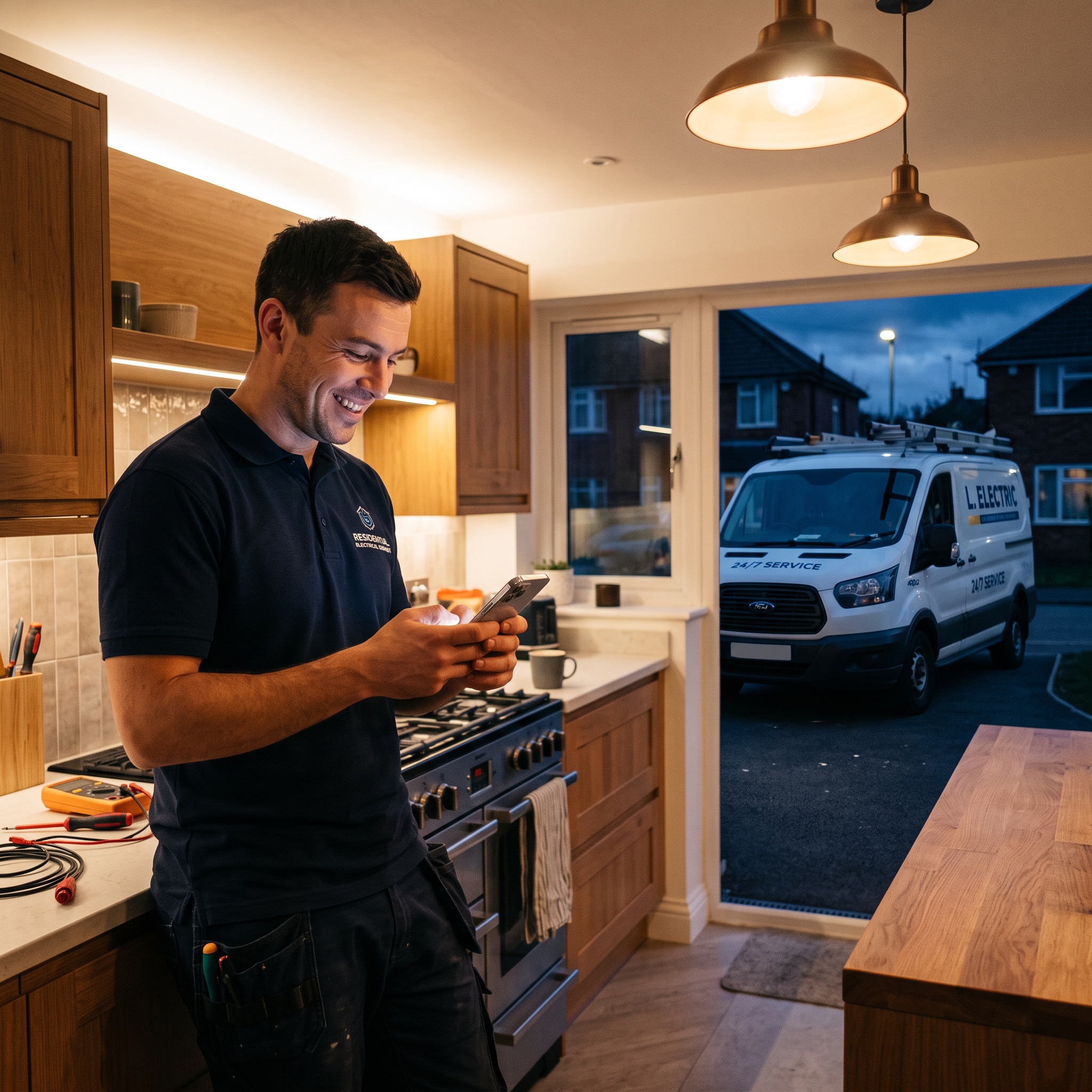
Electrical work has a phone problem that most trades don't: the person calling you is often scared. A burning smell from the panel, half the house dark, an outlet that sparked when the toaster went in — these callers aren't comparison shopping at their leisure. They're dialing down a list, and they're hiring the first electrician who actually answers and says "we can be there."
Meanwhile, you physically cannot answer. You're elbow-deep in a live panel, on a ladder, or on a commercial site where pulling out your phone mid-task isn't just unprofessional — it's unsafe. Every electrical contractor lives this contradiction: the calls that matter most arrive while your hands are least free.
So what does it actually cost to have your phone answered 24/7 in 2026? Here's the honest breakdown across the four real options — traditional answering services, virtual receptionists, in-house staff, and AI answering platforms — including the surcharges that never make the pricing page.
The Short Answer
For a typical electrical contracting business handling 100–400 calls per month:
| Option | Typical Monthly Cost | True 24/7? | Books Jobs? | Handles Emergencies Well? |
|---|---|---|---|---|
| Traditional answering service | $250–$1,400+ | Yes, with surcharges | Rarely — takes messages | Relays a message; you still call back |
| Virtual receptionist service | $400–$1,600 | Often a paid upgrade | Sometimes, premium tiers | Better, but minutes burn fast |
| In-house receptionist | $3,000–$4,200 per shift | No — 3 shifts = $9,000+ | Yes | Only during their shift |
| AI answering platform | $99–$499 flat | Yes, included | Yes — books to your calendar | Qualifies urgency instantly, every time |
Notice the pattern: every human-based option either charges by usage (so emergencies cost extra) or by shift (so nights cost triple). Let's walk through each.
Option 1: Traditional Answering Services ($250–$1,400+/Month)
The classic call center — live operators answering with your company name — prices two ways in 2026:
Per-minute pricing runs $0.90–$1.70 per minute. Electrical calls skew long because callers need to describe symptoms they don't understand. "The lights flicker when the AC kicks on" turns into a five-minute conversation about the age of the panel, whether anything smells hot, and whether this is a today problem or a this-week problem. At $1.25/minute, 250 calls averaging 6 minutes is roughly $1,875 in a month — for a service that mostly writes down a name and number.
Per-call bundles run $200–$350 for 100 calls, with $2–$3+ overage per call beyond the bundle. Storm season is the trap here: one bad wind event knocks out power across your service area and your call volume triples for a week. The bundle sized for your average month evaporates, and the overage bill lands in the same week you're paying overtime.
Then come the fees that don't appear in the ads:
- After-hours and holiday surcharges of 1.5x–2x — and electrical emergencies concentrate at night and on weekends, when a homeowner finally notices the breaker that keeps tripping
- Setup fees of $50–$150
- Patch-through charges of $0.75–$1.50/minute to connect a panicked caller to your on-call electrician
- Message relay fees on legacy services that still charge to send you a text
The deeper problem is what happens after the answer. A message-taking service tells a homeowner staring at a scorched outlet, "Someone will call you back." That customer doesn't wait. They keep dialing. The first electrician whose phone produces a booked appointment — not a promise — wins the job. You paid for the call; a competitor got the $800 emergency visit and possibly the $4,500 panel upgrade behind it.
Option 2: Virtual Receptionist Services ($400–$1,600/Month)
Virtual receptionist companies (Ruby, Smith.ai, AnswerConnect and similar) offer better-trained operators who can answer basic questions and — on higher tiers — book appointments.
Typical 2026 pricing:
- Entry plans: $300–$450/month for 50–100 receptionist minutes
- Mid plans: $700–$1,000/month for 200–300 minutes
- Heavy usage: $1,500+ once you pass 500 minutes
Two catches hit electrical contractors specifically:
- True overnight coverage is frequently an add-on, not the default. Many plans cover extended business hours; genuine 24/7 costs more. But the sparking-outlet call at 11 PM is exactly the one you can't miss — it's premium emergency work, and it's a customer who will remember whoever answered for the next twenty years of electrical needs.
- A 200-minute plan is only 30–35 real calls. Electrical inquiries run long, and a receptionist who can't answer "do you handle aluminum wiring?" or "can you pull the permit?" burns minutes transferring or taking messages anyway. Past your bundle, you're paying $1.50–$2.75 per additional minute.
Virtual receptionists are a real step up in call quality over a call center. But you're renting human minutes, and human minutes are expensive precisely when you need lots of them.
Option 3: In-House Receptionist ($3,000–$4,200/Month — Per Shift)
Hiring your own office staff gets you someone who knows your service area, your electricians, and the difference between a service call and a service upgrade. For one business-hours shift, expect:
- Wages: $17–$24/hour depending on market — roughly $2,900–$4,200/month with payroll taxes
- Benefits, PTO, sick coverage: add 20–30%
- Software, phone, workstation: $100–$300/month
That covers 40 hours a week. There are 168 hours in a week. Staffing nights, weekends, and holidays means three shifts plus relief coverage — $9,000–$12,000+ per month, which is enterprise overhead for an owner-operated shop running two or three trucks.
So most electrical contractors do what's actually affordable: office help during the day, voicemail at night. Which means the highest-ticket, highest-urgency calls in the entire business — the ones where a frightened homeowner will pay emergency rates without blinking — get the worst possible answer: a beep.
Option 4: AI Answering Platforms ($99–$499/Month Flat)
The newest option, and the one rewriting the math: AI receptionists that answer every call in seconds, 24/7/365, with no per-minute meter running.
Modern AI answering platforms built for home services do far more than transcribe voicemail:
- Answer instantly, every time — midnight on a holiday weekend costs the same as Tuesday afternoon
- Qualify urgency — sparking panel vs. flickering light vs. quote for a ceiling fan install
- Book jobs directly onto your schedule instead of taking a message you have to return
- Text back missed calls immediately, capturing the callers who hang up rather than leave voicemail
- Follow up on quotes and reviews automatically, so the estimate you sent Tuesday doesn't die in an inbox
Pricing is flat and predictable. Omni AI, built specifically for home services businesses, runs $99/month for its Solo tier — an AI receptionist, intake specialist, scheduler, and sales manager, with missed-call textback and Google review management included. The Growth tier at $199/month adds win-back sequences, a Monday business snapshot, and CRM integrations, and the Professional tier at $499/month adds a full AI executive layer and multi-location support.
Run that against the alternatives during a storm week: the traditional service bills you per-minute for every panicked caller, the virtual receptionist plan blows through its bundle by Wednesday, the in-house model needs a night shift that doesn't exist — and the AI platform costs the same $99–$199 it cost during the quiet week. No usage penalty, no after-hours surcharge.
The honest trade-off: an AI receptionist isn't a human, and some callers will always prefer one. But be precise about the comparison. At 11 PM, AI isn't competing with your best office manager — it's competing with your voicemail. It isn't replacing a person. It's replacing silence.
The Real Cost Isn't the Service — It's the Missed Calls
Whatever option you price, weigh it against the cost of doing nothing. Run your own numbers:
- Missed calls per week — trades businesses routinely miss 20–30% of inbound calls; call it 8–10/week if you're average
- Percentage that are real jobs — typically 50–60%, so 4–6 lost opportunities
- Average ticket — $300–$500 for service calls, $800+ for emergency work, $3,000–$8,000 for panel upgrades and rewires
- Booking rate if answered — the first electrician to answer and book wins most of these
Even conservatively — 4 lost jobs a week at a blended $450 average and a 50% close rate — that's $3,600/month in revenue walking to competitors. One saved panel-upgrade lead pays for a year of AI answering by itself.
That's why "what does a 24/7 answering service cost" is the wrong final question. The right one: which option converts the most of those lost calls into booked work, at a price that doesn't spike the same week your workload does?
Bottom Line: What Should an Electrical Contractor Pay in 2026?
- Low call volume, message-taking is enough: a traditional service at $250–$500 covers the basics — just read the surcharge schedule before signing
- Growing shop with real after-hours volume: a virtual receptionist at $700–$1,000 works if you watch the minutes — or an AI platform does more for a fifth of the price
- Most owner-operated electrical businesses: a flat-rate AI answering platform at $99–$199/month delivers true 24/7 coverage, books jobs instead of taking messages, and costs less than one recovered service call
If you want to see exactly what that looks like line by line — what each tier includes, what it replaces, and how the math compares to a human receptionist — check out the full Omni AI pricing breakdown. It's the fastest way to compare real numbers against what you're paying (or losing) today.
Somewhere in your service area tonight, a breaker is going to trip and refuse to reset. The homeowner is going to start calling electricians in order. The only question is whether your phone produces an answer — or a beep.
Get the AI Playbook — $29
46 copy-paste prompts for marketing, sales, service, operations & finance. 90-day implementation plan included.
Get the PlaybookAI Prompt Pack for Real Estate Agents — $29
60+ prompts built from $250M+ in real transactions. Listings, negotiations, social media, sphere management.
Get the RE Prompt PackAI Social Media Content Calendar Kit — $29
Plan 90 days of content in under 1 hour. 35+ AI prompts, 12-week calendar, strategies for Instagram, LinkedIn, TikTok, Facebook & X.
Get the Calendar KitThe AI Email Marketing Playbook — $29
40+ copy-paste prompts for welcome sequences, sales funnels, newsletters, automation workflows & A/B testing. Build campaigns that convert.
Get the Email PlaybookThe n8n Automation Cookbook — $29
25 ready-to-deploy workflows for lead capture, CRM, invoicing, email, social media, reporting & e-commerce. Save $774/yr vs Zapier.
Get the n8n Cookbook✭ Complete AI Marketing Toolkit — All 5 Products for $119 (Save $26)
195+ prompts + 25 workflows across business, real estate, social media, email marketing & automation. One purchase, lifetime updates.
Get the Complete Bundle